
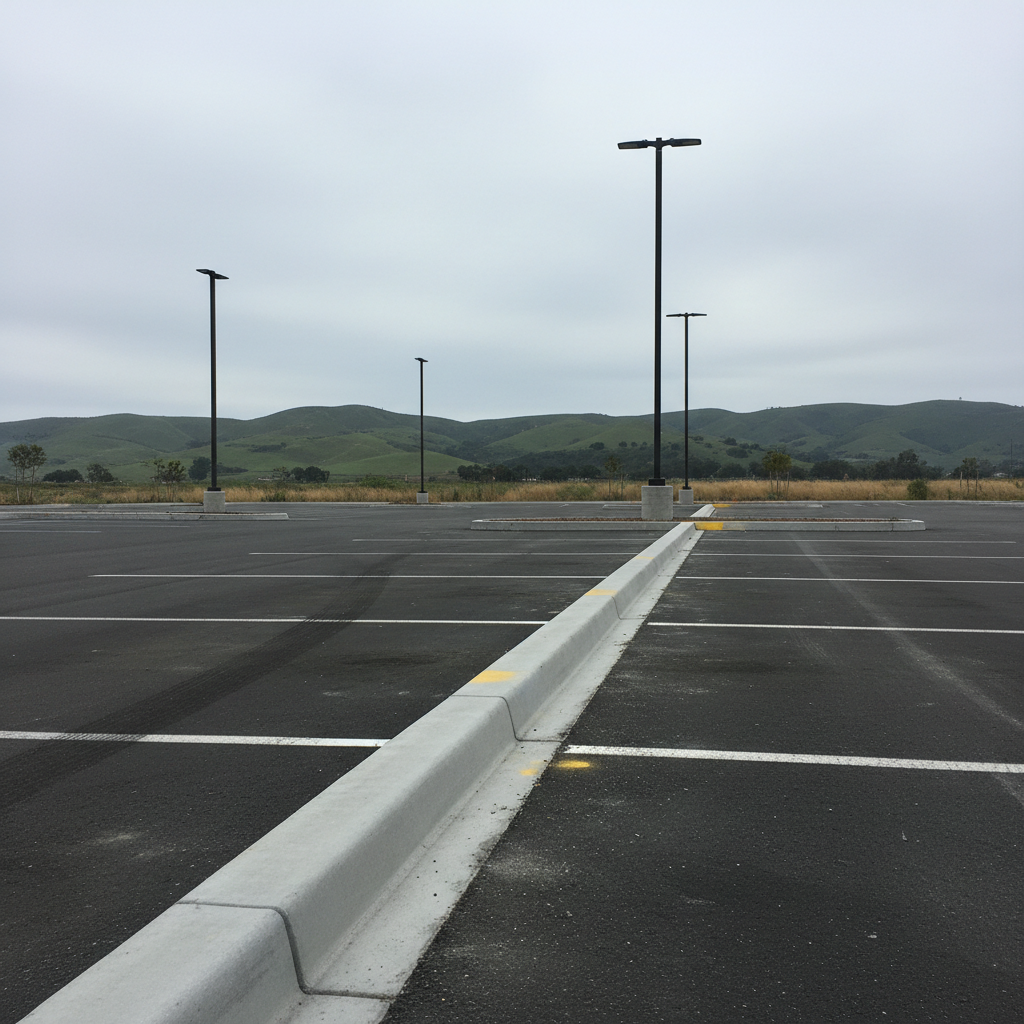
Fontana sits on the alluvial fan coming off the San Gabriel Mountains, so most lots here are sandy loam or decomposed granite, fast-draining and relatively stable. That's a decent base to build on compared to the heavy clay you get closer to the valley floor in parts of Chino or Riverside. But "decent" isn't "ignore it." There are pockets of older adobe-type clay in low spots around town that swell when they get wet and shrink hard in August, and a contractor who doesn't test or at least ask about the soil on your specific lot before bidding is guessing.
What's actually under your slab matters more than what's on top of it
A driveway or patio fails from the bottom up almost every time. Cracking, settling, that low spot where water pools after a storm, it almost always traces back to the base, not the mix. A proper base is compacted class II road base, usually 4 inches minimum, more if the native soil is soft or if you're pouring over old fill. Ask whether they're compacting it with a plate compactor in lifts, or just dumping it and driving the truck over it a couple times and calling it good. Those are very different jobs that look the same once the concrete goes down.
On a lot with any grade change, I also want to know where the water goes. Fontana gets most of its rain between December and March, and when it comes it tends to come fast, a heavy downpour on baked, hard-packed dirt that doesn't absorb it well. A driveway or patio poured dead flat, or worse, sloped toward the house, is a problem you won't see until the first real storm. A contractor who talks about grading and where the slope drains before you even ask is one who's thought about this before.
Reading a bid like it actually tells you something
Three bids can look close on price and be three completely different jobs. Here's what to check line by line:
- Thickness. 4 inches is standard for a driveway or walkway. If you're parking an RV or a dually on it, you want 5 to 6 inches, or thickened edges at minimum.
- Reinforcement. Rebar on an 18-inch grid holds a slab together better than 6x6 welded wire mesh, especially once a crack starts. Mesh is cheaper and a lot of bids still spec it. That's not automatically wrong, but you should know which one you're paying for.
- PSI rating. 3,500 to 4,000 psi concrete for driveways and anything that'll see regular vehicle weight. Cheaper 2,500 psi mix is fine for a decorative garden path and nothing else.
- Control joints. These should be cut within 24 to 48 hours of the pour, roughly every 8 to 10 feet, so the slab cracks where you want it instead of wherever it decides to.
If a bid is a single number with no breakdown of thickness, base depth or reinforcement, ask for it in writing before you sign anything.
Permits in Fontana aren't optional, and skipping them costs you later
Most driveway, patio, slab and retaining wall work in the city goes through Fontana's Building and Safety division. A new driveway approach that touches the public sidewalk or curb cut usually needs sign-off since it affects city right-of-way. Retaining walls above a certain height, typically around 3 to 4 feet, need a permit and often engineered drawings, because a wall that fails can take a fence, a slope or a neighbor's yard with it. Foundation work gets a pre-pour inspection, where the inspector checks rebar placement and sub-grade compaction before any concrete touches the ground. Skip the permit and you may be fine for years, or you may hit it when you sell the house and the buyer's inspector flags unpermitted work. If you're in a newer tract like Sierra Lakes or Heritage, add an HOA architectural review on top of the city permit, since those associations usually want to approve patios, walls and anything visible from the street before work starts.
A contractor who's done permitted work in Fontana before will know this timeline and won't act surprised by it. One who tells you permits are "usually not needed" for a retaining wall or a slab addition is either inexperienced here or hoping you don't ask twice.
Questions worth asking before you sign anything
Check their CSLB license number yourself rather than taking their word for it, it takes two minutes on the state's website. Ask how many days before you can drive on a new driveway, the honest answer is 5 to 7 days for light use and closer to 28 days for full cure strength, which is when the concrete actually reaches its rated psi. Ask who's running the crew on pour day, not just who answers the phone. Ask what happens if it rains during the cure, since Fontana's summer pours also need a plan for heat, because 100-degree days in July and August can flash-cure the surface and cause crazing if nobody's water-curing or using a curing compound.
A written contract should spell out thickness, mix design, reinforcement type, base prep, and a payment schedule tied to actual progress, not a lump sum collected up front.
What should make you walk away
A bid dramatically lower than the others almost always means something's getting skipped, usually the base prep or the rebar, because concrete itself is a small part of total cost compared to labor and site work. No license number, no insurance certificate, no written contract, those are all separate reasons to say no. So is a contractor who wants the full amount in cash before a single yard of concrete gets poured. And if nobody on the crew can tell you how many inches of base they're putting down or where the control joints are going, they haven't done enough of these to be trusted with yours.
None of this is complicated once you know what to listen for. It's the same five or six things on every job, whether it's a patio, a driveway, a retaining wall or a foundation repair. If you want someone to walk the lot and tell you straight what it needs, that's what Stoneforge Concrete Co does for homeowners across Fontana and the surrounding towns.